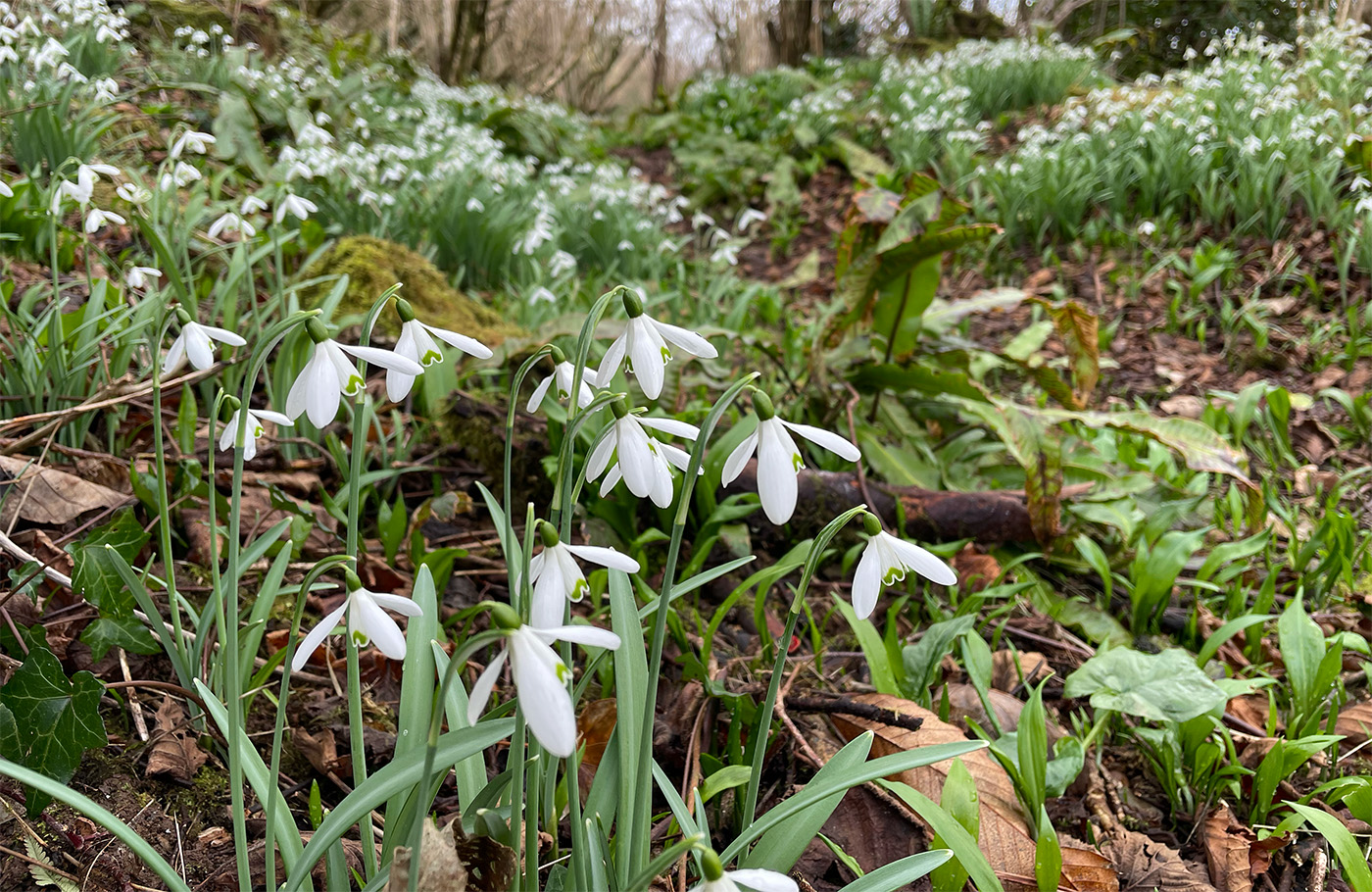
When we first bought our woods in the 1993 we planted a small clump of snowdrops from our friends Bernie and Jeanie Skewes’s garden. (Bernie was a sign writer, poet, poacher and actor, who’s claim to fame was as the first UK Tarzan in the 1930s and the author of a Poacher’s Tale – a gentle 1970s TV show about the bizarre. His wife Jeanie was a wonderful artist and a keen gardener, hence the snowdrops).
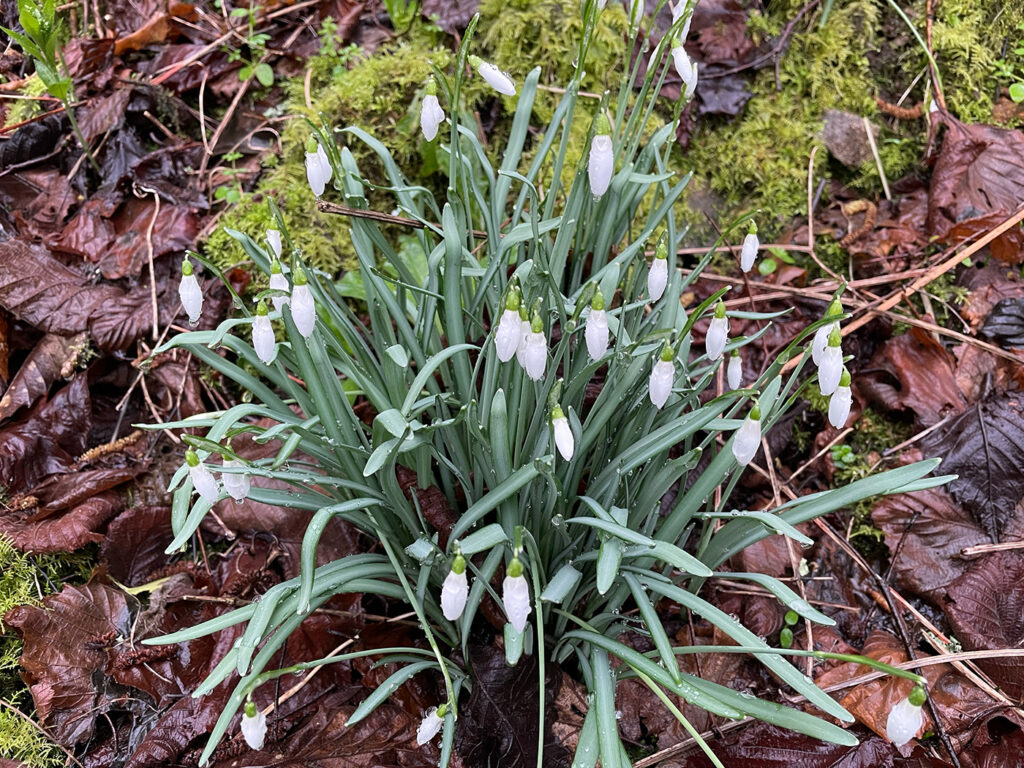
The snowdrops remained in a small clump, slightly spreading, but never seeming to do very much. However in 2015, after a bout of flu, I was taking a slow walk in the woods when I saw a streak of white near the boundary of the railway, running along what I believe may have been an ancient track.
Further investigation showed that our snowdrops had marched down the steep hill and along the path of the railway. This was just the incentive we needed to clear this lower track.
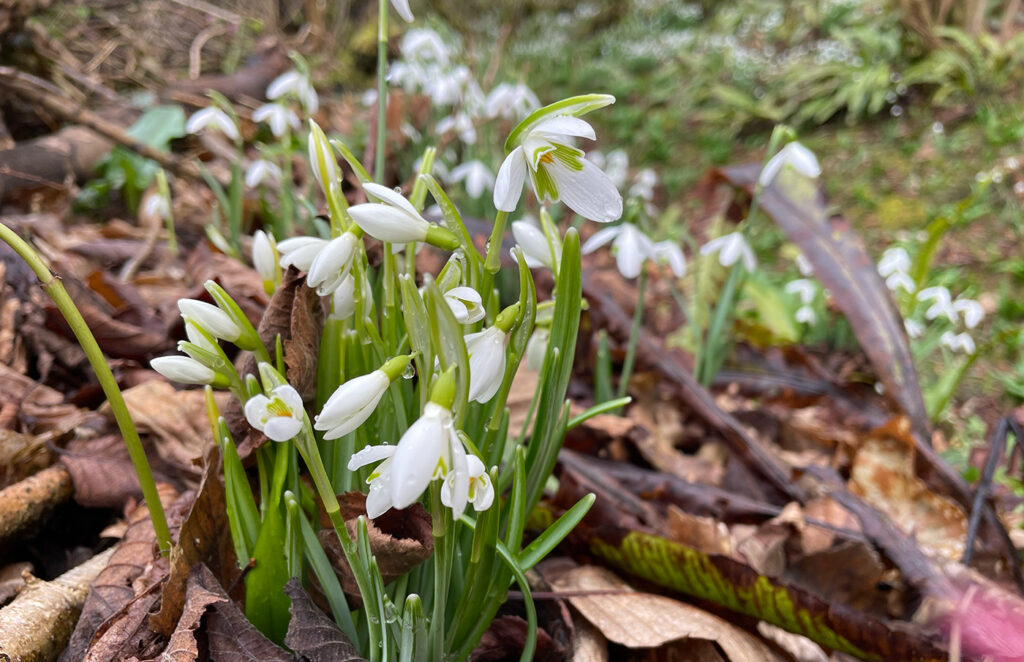
Since my chance discovery, and the revelation that snowdrops will thrive in our woods, we have laboured every year to create a magical snowdrop walk. We’ve cleared fallen trees, brambles and nettles and scrounged snowdrops from every keen gardener we know. We’ve also divided clumps. Now we have a really decent stock of flowers, it’s allowed us to ramp up a gear, moving thousands of bulbs each season from the bottom of the woods to higher up where they will be seen. It is our intention that one day the whole woods will be a blaze of white in January and February, but until then the paths look better every year.
In addition to flowers from friends, all of which are distinctly different, we’ve collected some species bulbs, for variety. These are spread along the paths to add another layer of interest. The bulbs have mainly come from Beth Chatto Gardens and Avon Bulbs.
Below is a brief description of what you might expect to see when on holiday in January or February.
Nivalis – the common snowdrop.
The big drifts you’ll see are primarily from local stock, grown in our woods and from our friends Jo and Lil Lanyon (Trerulefoot), Dave and Pat Lillyman (Yelverton), my parents Tony and Frankie Lister (Saltash) and Rob and Fiona Sneyd (Menheniot). You will also see some with just the tiniest pale green markings. These come from the garden of my Great Uncle John, who lived in Hope Under Dinmore, near Leominster, Herefordshire.
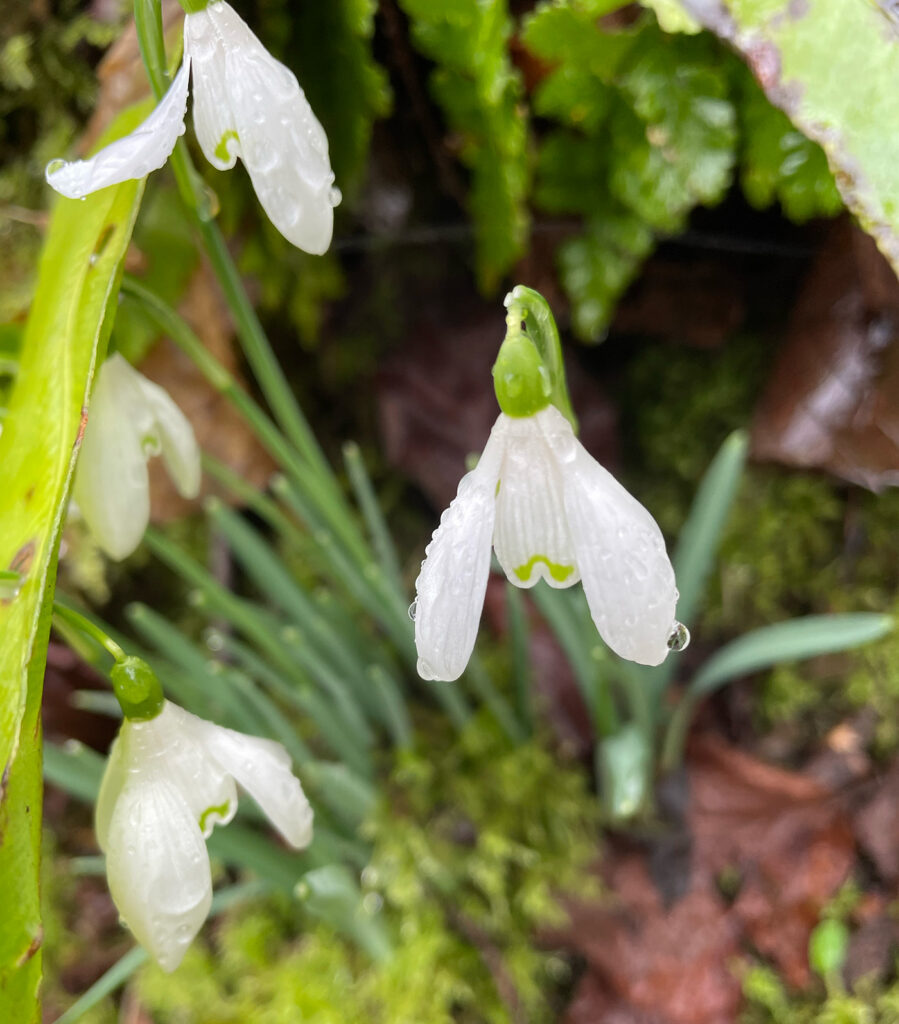
Early snowdrops:
Captain James Backhouse and Atkinsii
These are our earliest snowdrops, and are very similar to each other. They are tall and handsome, holding onto their flowers for a good length of time.
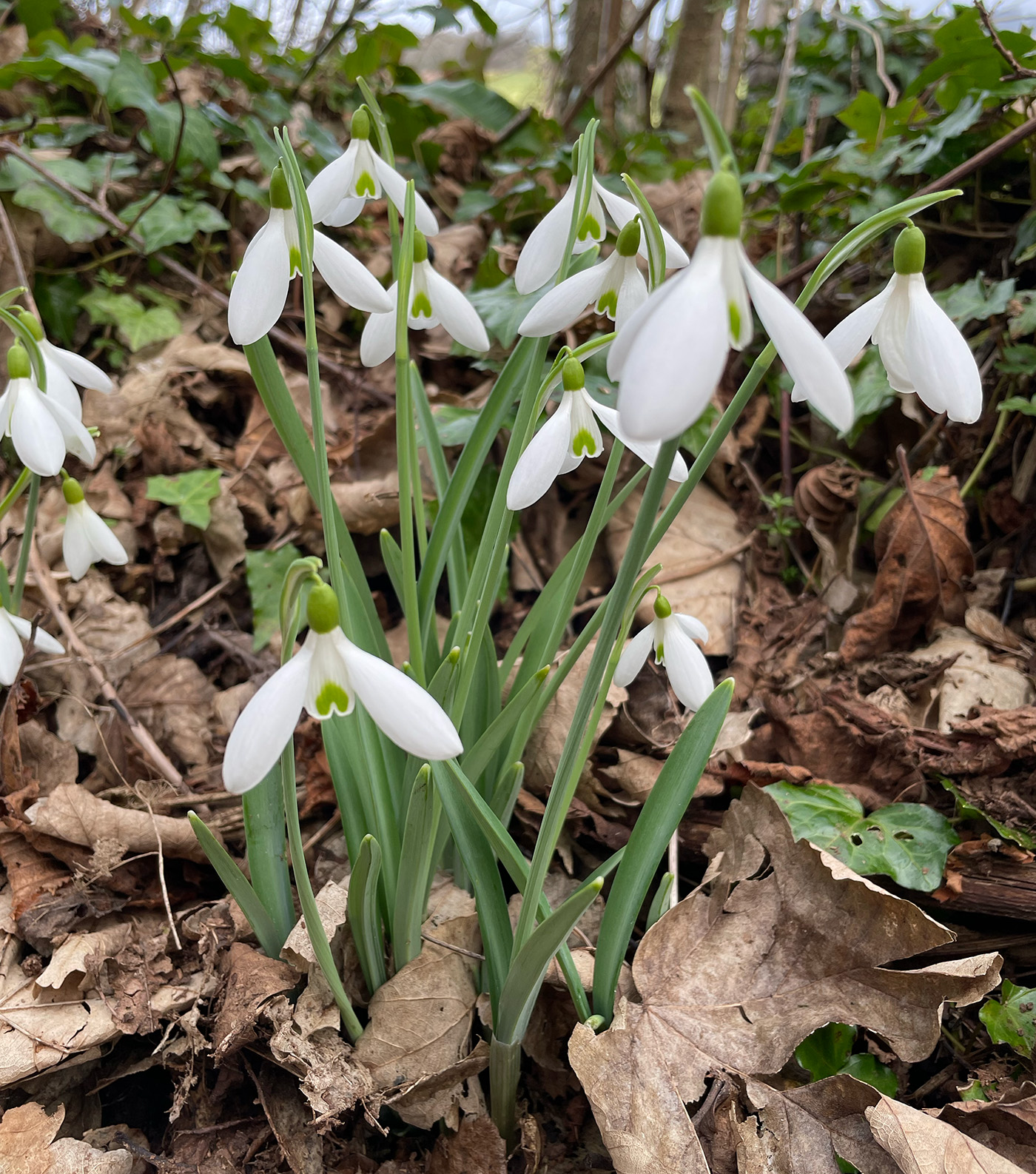
Mid season:
Greatorex Snowdrops
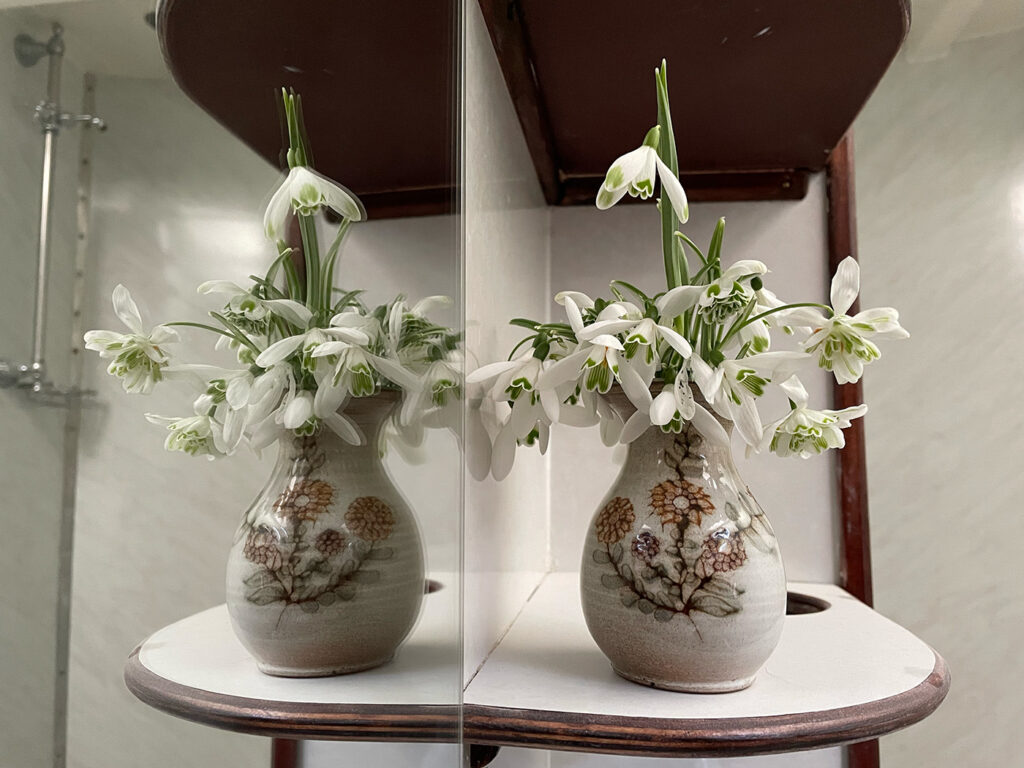
The Greatorex Snowdrops are tall doubles, with deep green colouration. We have four types; Hippolyta, Ophelia, Desdemona and Dionysus. They are all pretty similar, but flower at different times from early January to late February.
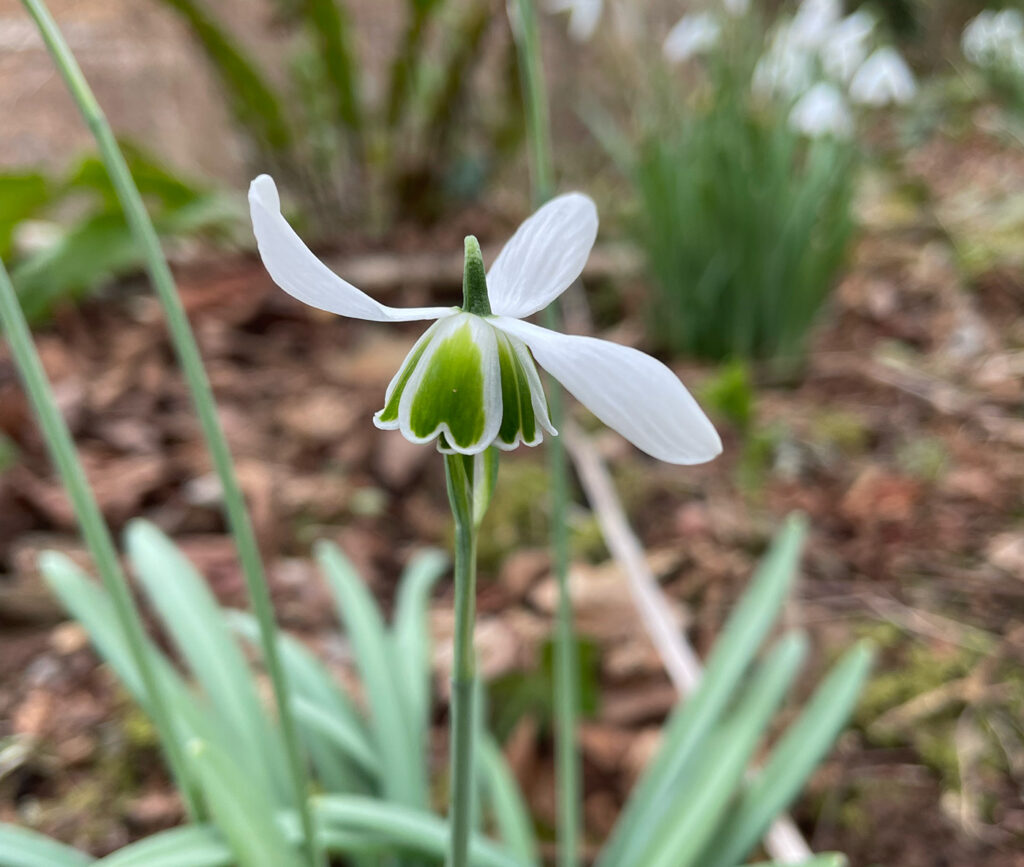
Double Snowdrops: Flora Plena
Our taller doubles come from Dave and Pat, Mum and Dad and Jo and Lil. The very short ones are from Rob and Fiona’s woods, near Menheniot, and are slightly later to flower.
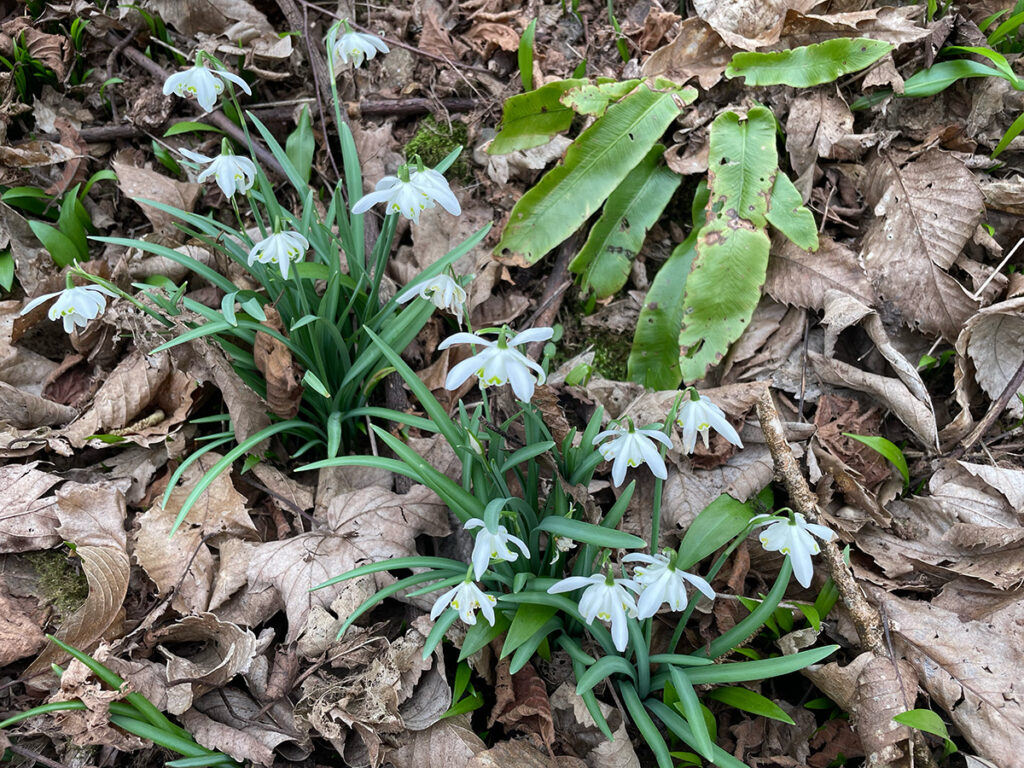
Magnet
Magnet is a lovely robust snowdrop held on a long pedicel. We also have Galatea, which is similar to Magnet, but flowers a little earlier.
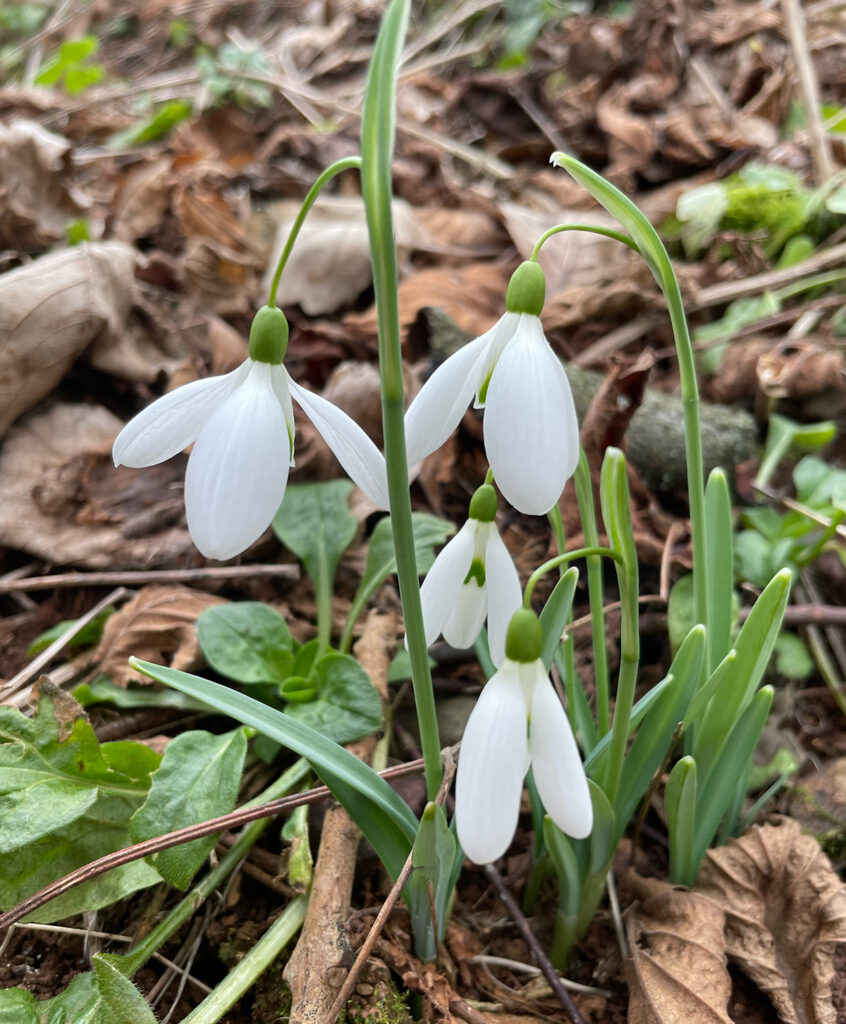
Large, mid season: probably Sam Arnott.
We have some Sam Arnott we have purchased, but we also have a good number of beautiful large snowdrops from our friend, the ceramicist Emma West, which I think are probably the same.
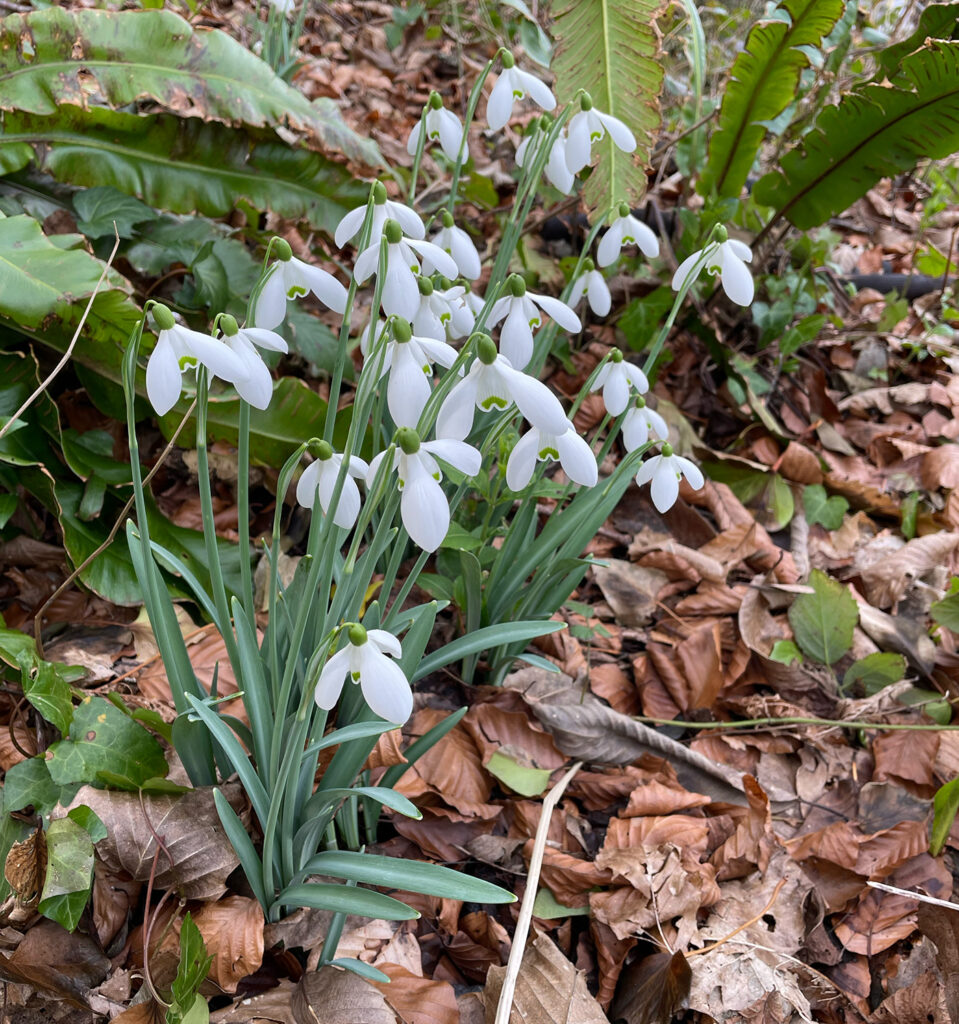
Nivalis Scharlockii – Green tipped snowdrops
Our green tipped snowdrop came as a surprise find in my parent’s garden. It is unusual in that it has very long spathe and pedicel. Their farm is only a mile from Ince Castle, where a green tipped snowdrop called Snow Angel was found, and it looks very similar, but I always call this snowdrop Frankie Lister, in memory of my Mum. This is a vigorous and healthy snowdrop, bulking quickly.
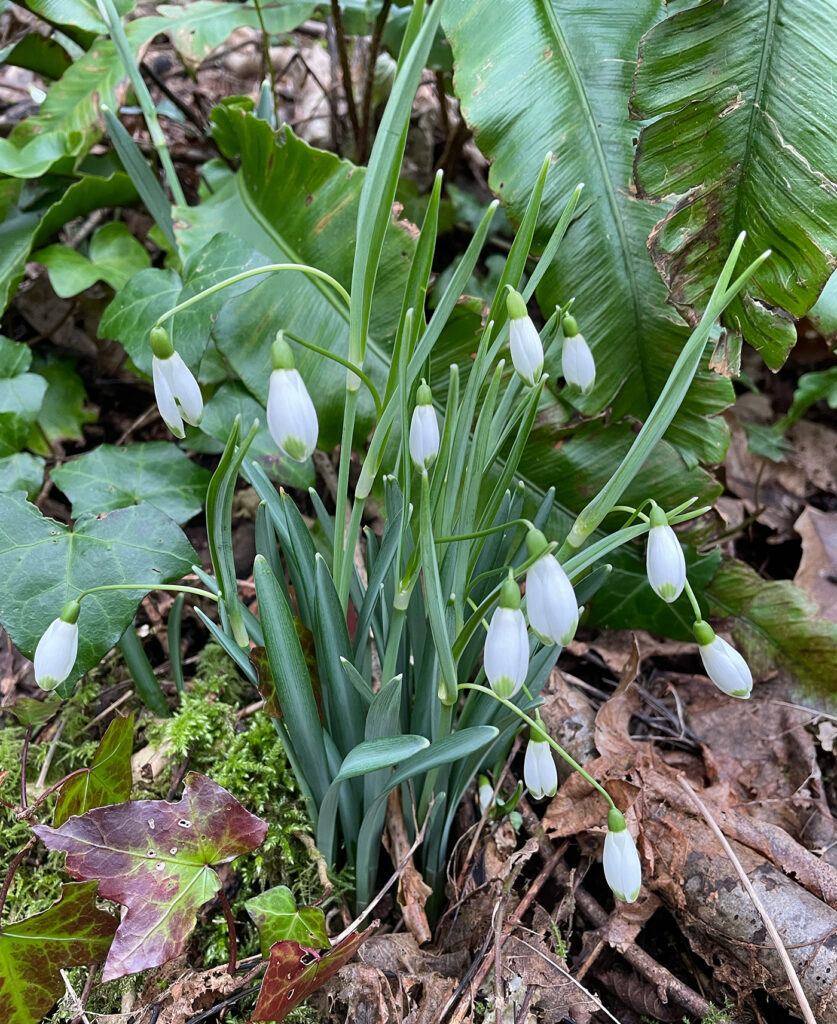
Elewsii snowdrop
Cedric’s Prolific is a wonderful plant, bulking up quickly and flowering for ages. It is tall and impressive. Of all our snowdrops, I would say that Cedric’s Prolific is probably the star performer in terms of longevity of season and vigour.
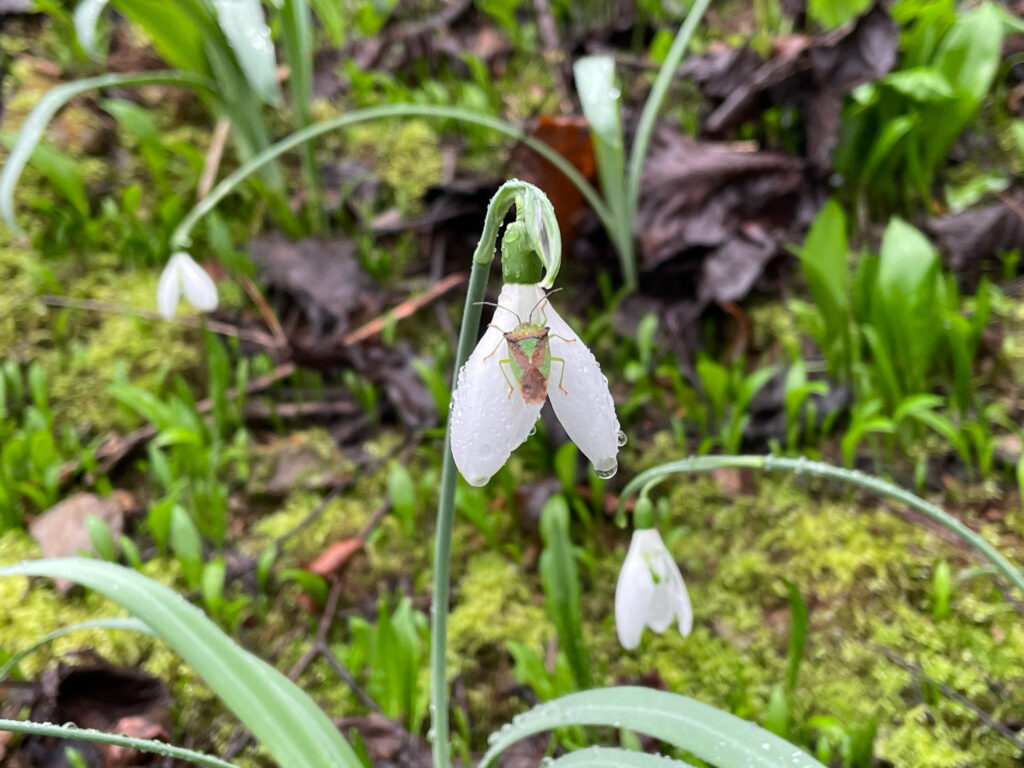
Late flowering snowdrops
We call our late snowdrop The Ceramicist, as it came from the garden of our friend Emma West. It looks very similar to the nivalis at St Raphael’s Chapel at Huccaby on Dartmoor.
The last of our woodland snowdrops to flower is Washfield Wareham, which starts to push through the ground in mid-February. At the moment we only have one small clump, but it is bulking up nicely.
We have a number of other species snowdrops that we display in our carriage gardens. We have found putting costly individual bulbs in the woods can be problematic, as they are prone to being damaged or destroyed by other wood dwellers. For this reason we only add to our woodland collection when we have a decent stock and can plant a decent sized patch. We’ll update here as and when the collection increases.
We have created a list of snowdrop orientated places to visit while on your winter holiday. To read all about it, please follow this link.
Finally a poem in celebration of my Mum, Frankie Lister, who helped me in the early planting of snowdrops. I know she’d be delighted with the progress we’ve made. This poem is based on a Japanese form called the Haibun. A short piece of poetry prose is ended with a haiku, and celebrates stumbling upon snowdrops she’d planted at their smallholding near Saltash.
When We Are Silent Our Landscapes Speak

I pick tree guards out of liquid sunset. Buzzards circle lazily on thermals above.
Beneath a pylon, the thirty-year old walnut trees you planted glow like bleached coral.

I miss your laughter, your stooped back, your work-gnarled hands.
I descend to the copse where lent lilies are just pushing up,
where blackthorn buds glow like fists of lichen,
the air rich with damp leaf-mould.

It is then I see them, your surprise gift;
the imprint of your spade on our lives.

Snowdrops float like ghosts -
Disembodied petticoats
Melting into dusk.