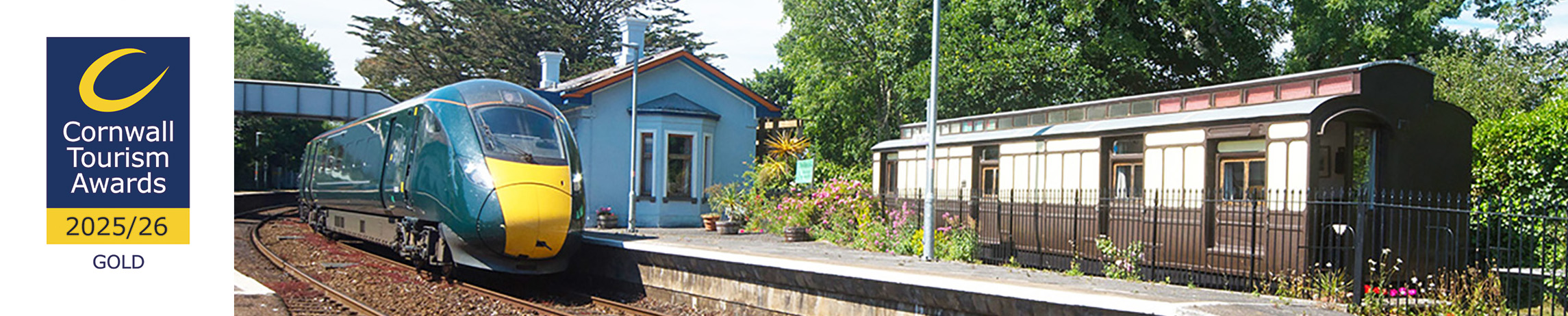
Although the story of Railholiday officially began on the 20th June, 1998, when we welcomed our first guests into The Old Luggage Van, the true beginnings came much earlier. Perhaps the story starts in March 1996 when Dave, on a train trip to Truro, spied a derelict carriage in a builder’s yard in Liskeard. Perhaps it starts a year earlier when a siding was discovered in the station garden, or in May 1992 when we bought the railway station in St Germans. Perhaps we could look to September 1991, when on a trip down to the Scilly Isles we spied an All Enquiries sign on the station building in St Germans, or January 1987, when Dave and I first started going out after meeting each other at Landrake Young Farmers. Maybe the story starts in 1975, when my father, Tony Lister, took on the role of farm manager for Port Eliot estate when I was four, or perhaps when Dave was first given his double-O-gauge railway set in the late 1960s, which was to spark a passion for railways that has lasted his whole life.
However every story needs a beginning point, so it makes sense for this one to start with purchase of the station at St Germans, as without that Railholiday could never have come into being.
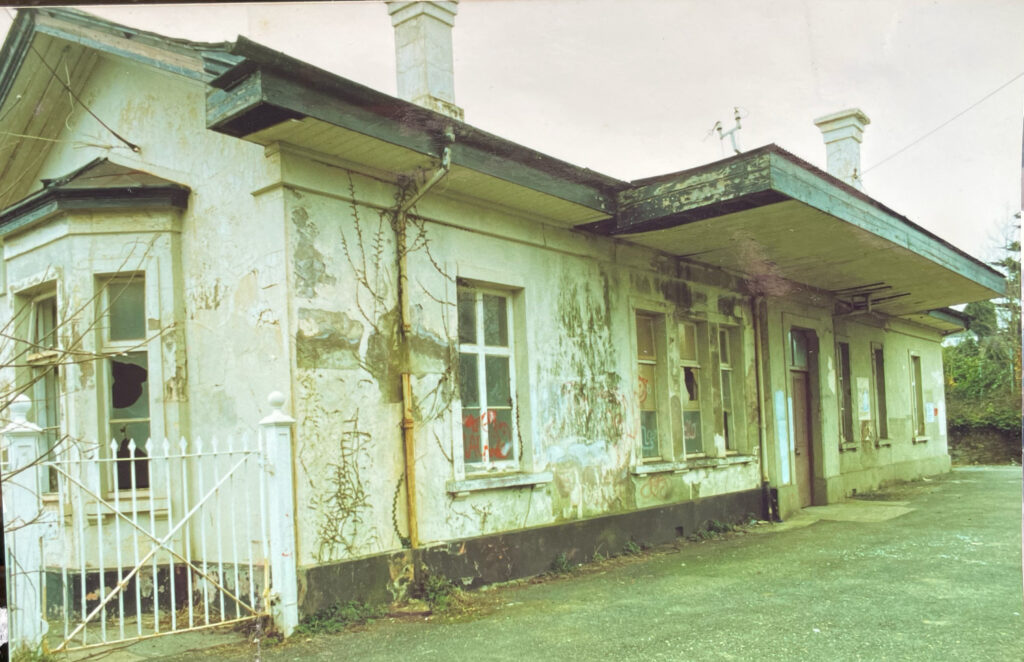
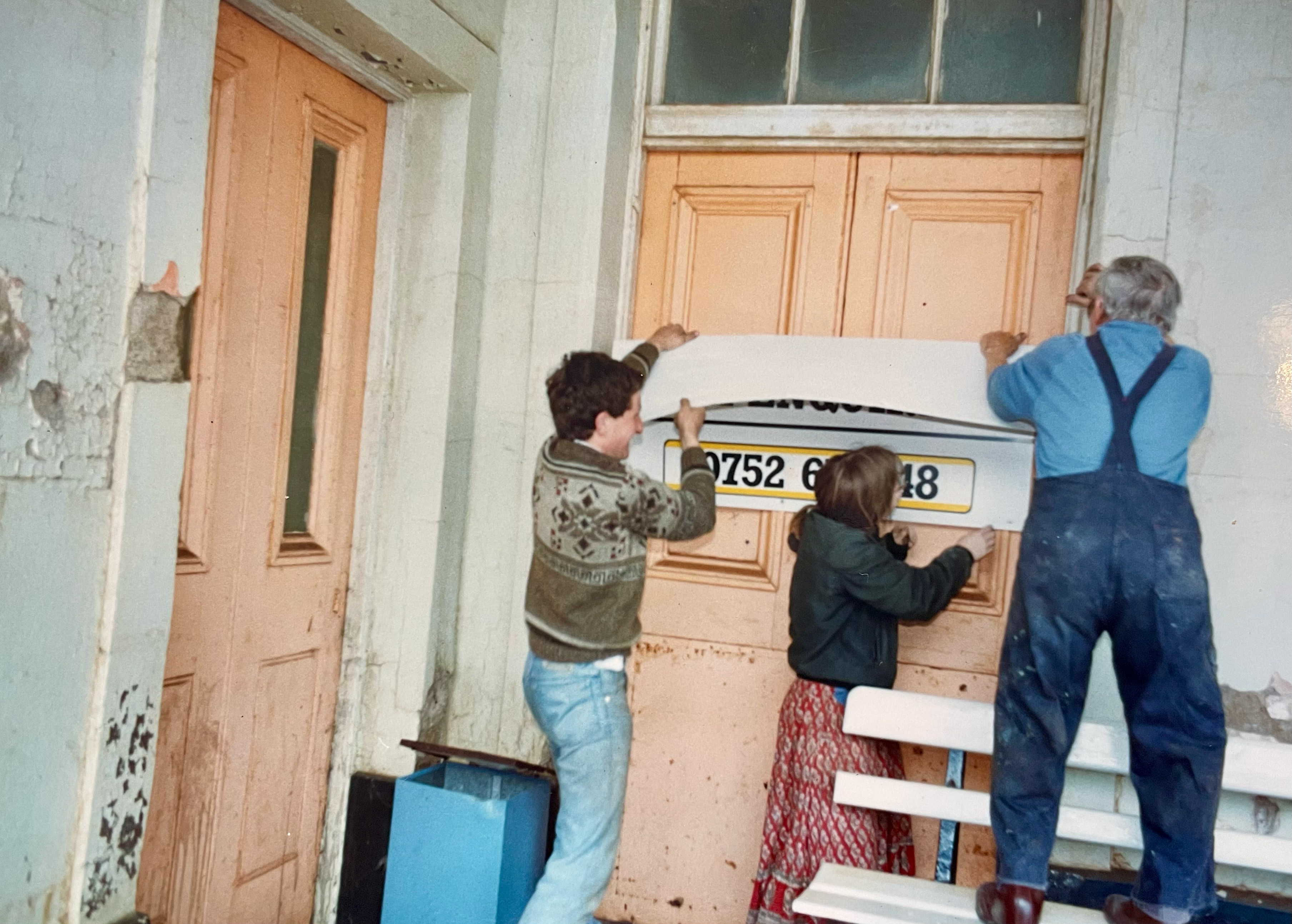
All Enquiries – St Germans Station
Although we both share a passion for train travel, neither of us could ever have imagined the direction our lives have taken. From the early days of our relationship we both loved travelling by train and our passion for travel led to Inter-railing across Europe, a journey overland to Turkey and exploring the railway networks of France. However, it was practicality that led to our purchase of St Germans station, rather than a desire to find a station-themed house.
We first started looking for a house in early 1991. At the time I was about to embark on my final year of a degree in English and Music at Bath College of Higher Education. Dave was living at home with his parents in Saltash running an agricultural engineering business. He had studied Agricultural Engineering at Silsoe, so much of his time was spent making bespoke machinery, decorative gates and railings and yard-scrapers, but he could turn his hand to any kind of metalwork, so also did one-off commissions.
Dave had saved up a deposit. However, as he was self-employed, his income was unreliable, which meant that securing a mortgage was not easy. We had been offered a maximum of £30,000 to buy our first house. At that time it was still possible to buy a small house or a flat in Torpoint or Plymouth for this kind of money. But we knew we wanted something a bit different, and for me the priority was to have a living space big enough for my grand piano. We looked at buying a tiny barn to convert in Liskeard, which at £12,000 was not a huge sum. However, the bank rejected it as the manager at the time felt the footprint of the building was too small to be worth the investment. We were very disappointed.
In the early 1990s banks were very different. The bank manager still oversaw mortgage decisions, and each case could be looked at in an individual way. Therefore although Dave’s income was unreliable, because he had been setting aside a monthly mortgage-equivalent sum for a few years , the manager could see that he was able to prioritise regular payments. However the bank manager was pretty severe in what he felt was mortgageable, and this seemed set to work against us.
In September, just before I started my third year, we caught a train from Saltash to Penzance and happened to spot an All Enquiries sign on the building. The week following I went back to Bath and Dave contacted the estate agent and had a look around. Dave was very excited by the prospect of buying the building because it had such a large footprint compared to other places of a similar price.
At the time it was for sale for £35,000 as a commercial building. There was no residential planning permission and the estate agent felt it would be unsuitable to convert into a house. However, Dave saw the potential. At that time it was not possible to view much of the internal space. The largest room, formerly the ticket office, had been used as a storeroom by the local milkman. Dave was able to access this, the former station master’s office, a small storeroom and the hall. The bay window at the end of the building had been smashed so he’d been able to climb in there and have a look at the former waiting room, which is now our music room. However, most of the doors had been blocked up for years and there was no through-passage to the centre of the building – we just had to guess.
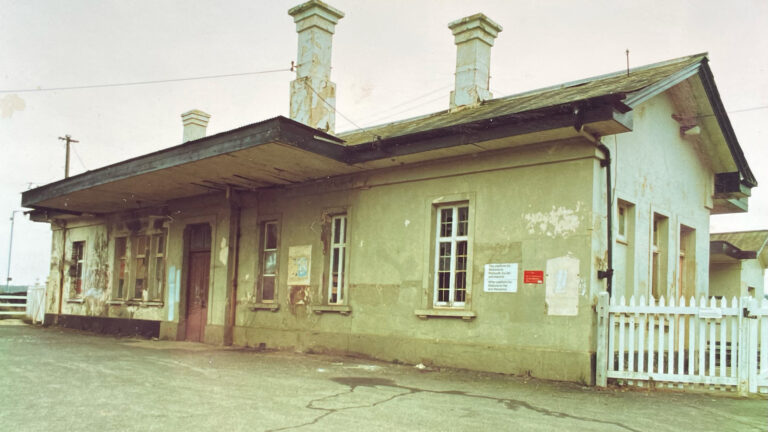
The station was in a sorry state. The drainpipes were rusted, the canopy sagged and boards hung precariously above the platform. The render was cracked and chipped, floors and ceilings were crumbling, windows smashed, walls adorned with green mould and graffiti, smiley faces, squiggles and the ubiquitous slogan I hate Maggie.
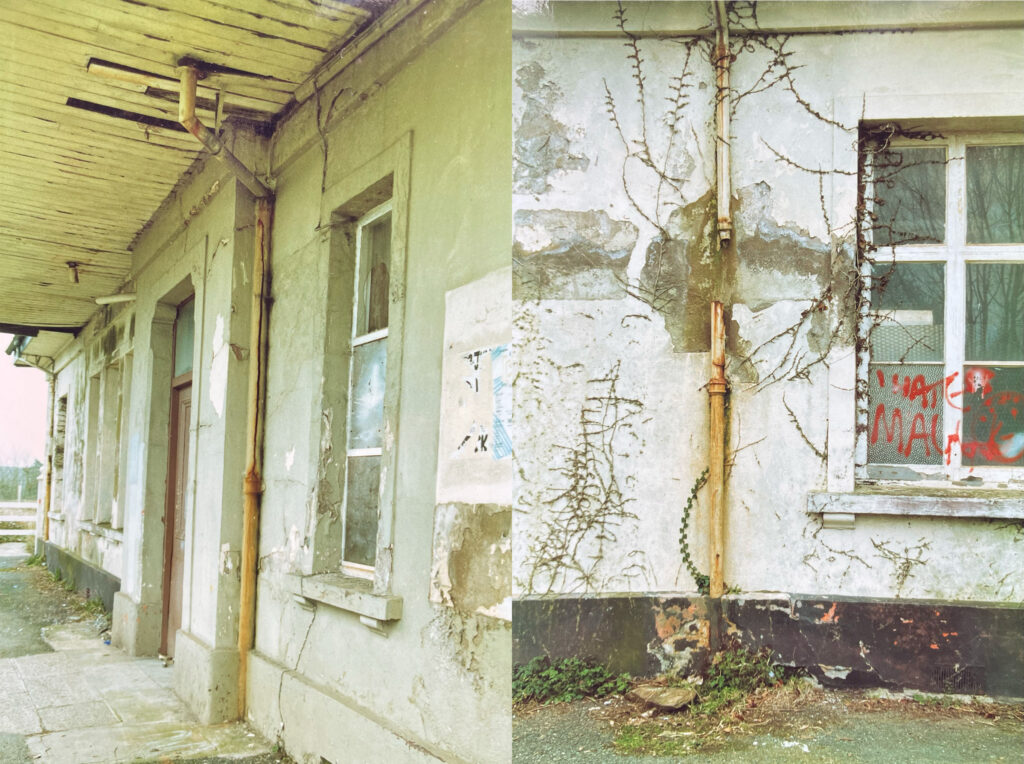
When Dave called me after viewing the property, he was full of enthusiasm, not least because of the size of the building. It was so much bigger than anything else we could have hoped for, and it had a large garden. However, although the asking price was very reasonable, it was still well beyond what we had been offered as a mortgage. We also needed to allow some money for restoration and conversion work. We contacted the vendors and offered them £27,000, which they accepted. Then the work really began.
We had a stroke of luck when it came to the mortgage. The bank manager who had previously refused us money had retired and a new bank manager taken his place. He was just into his new role when we put in our application for a mortgage. We had a builder friend who checked the structure was sound. A surveyor valued the rebuilding cost at £128,000, and said the property would be considerably more valuable than the asking-price once work was done. Therefore, if our restoration of the building was successful the bank wouldn’t risk losing money, should we fall behind on payments.
However, the place looked a complete mess. Several people commented that they thought we were mad to even consider it.
A year after purchase, the bank manager did finally visit, and his face looked like he’d seen a ghost; he was so shocked by the external appearance of the building. Luckily we’d done quite a bit of work inside, so he was reassured. He’d just come from another property where they’d got the outside looking picture-perfect, but completely stripped the inside, then run out of money. He was visibly relieved when he stepped into our newly restored kitchen!
Securing the mortgage was just one of the hurdles we had to jump through. The greatest trouble of all was getting planning permission to convert the station into a house. At the time the assigned planning officer was not keen at all and did all he could to make sure that planning permission was refused, despite telling us he was on our side.
The problem may have been that there was a sewage embargo on St Germans at that time, but the officer was not able to refuse planning on this count because originally the station had two toilets. Therefore if the station was restored to its original purpose (which wouldn’t have required any permissions) there would have been more toilets than the one we had built into our plan.
The planning officer threw everything else he possibly could at the application, including noise, vibration, setting a precedent and more. To counteract this we trawled through government documents, found other station buildings that had been converted into houses, and used building regulations in order to counter attack all of his arguments. We added triple glazing to our application, and a floating floor to reduce vibration.
At that time Cornwall was not a unitary council, but divided into districts. We were in the district of Caradon. The planning committee was made up of members from throughout the area. We travelled the width and breadth of South-East Cornwall, visiting each committee member individually with our documents, giving them a copy and explaining why we felt that planning permission should be granted. I was unable to be there at the time of the meeting, but Dave was. Apparently every single councillor, bar one, spoke in favour of our application, and the planning officer was completely overruled. We were very lucky that our representative on the panel was a woman who was known for saying no to things, but was very positive towards our application. She was pleased to be able to support a local young couple who were looking to create a home in the community.
We finally got planning permission nearly eight months after placing our original offer. The vendor was very reasonable, only requesting an additional £750 for the wait. She could easily have relisted the property with planning permission and raised a far greater sum than she was originally asking for, but was kind and honourable, for which we were very grateful!
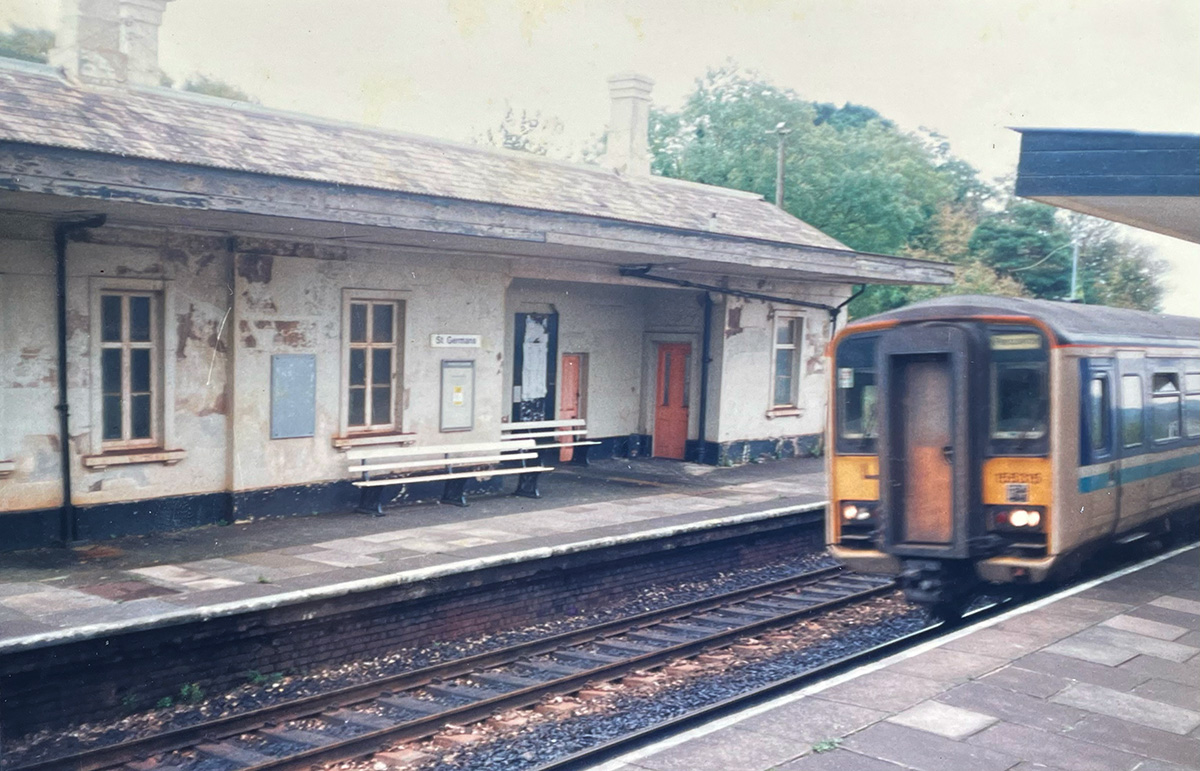
The vendor, Rosemary Gould, had actually bought St Germans station completely by chance. In the mid-1980s, British Rail Property Board sold many stations and parcels of land that it felt it were no longer needed; St Germans station was one of many sold at this time. On the 19th September 1985, Rosemary had attended an auction intending to buy a different station. Unfortunately when she got to the auction she was too late and it had already been sold. So instead she bought two other stations; St Germans and one on the Barnstable line. The intention was to convert both into holiday accommodation, but the first conversion cost a lot more than anticipated and so St Germans station was sold as a means of raising funds.
Rosemary did well from the sale because she paid £8500 in total for the station (£6000) and land (£2500), so it was a win-win all round. Nothing had been done to the station since its sale, so she was pleased to know that someone would be taking care of it, and came to visit us a few years after we bought it.
Although it was sold in 1986, St Germans had closed as a station in the mid ‘60s. It had then been used as a place for making radio parts, before its final incarnation as a milk store. The milkman wasn’t terribly happy about being ousted, but had been offered the chance to buy it before us. He told us “Six thousand pounds they paid for it. I wouldn’t give them six thousand pennies!” Needless to say he was one of the many who thought we were mad!
Having completed the purchase, and planning permission in place, we still had a final hurdle. There was no water to the building. We turned on all the stopcocks, but there was nothing. Eventually we hired a cat-and-mouse pipe detector to find where the pipes went. To our alarm they were fed from the other side of the railway and there was clearly a break at some point. Where, we had no idea. If it was under the rails we were clearly in for some fairly massive unexpected (and unbudgeted) problems.
Thankfully it transpired the pipe had been cut close to the stopcock on the other platform. We were able to mend the join and arranged to buy water and sewer services from the railway. This was sorted a month after purchase. Phew! A good resolution to a very stressful situation.
When we bought the station our ownership stopped at the walls, with the garden being a few metres away across the station carpark. The carpark outside the house was still owned by the railway and it would be several years before they offered to sell it to us. As a result we were sitting in a sea of railway property. In the early days we were quite used to being surrounded by railway workers, commuters and other people who were using the train. It was often a very busy place, particularly in the mornings and sometimes in the afternoons when the youth of the village would hang out.
The station was finally ours on the 4th of May 1992. Because we were getting married on the 18th of July and intended to move in as soon as we had got married, there was no time to lose in preparations. The night that we bought the station we slept in sleeping bags on the floor of what would become our kitchen. At around about midnight there was a sound of footsteps walking through the room, but there was no-one around. I like to feel it was a sign that we were being passed on the custody of the building from somebody who had been there before us, and they were simply leaving. The following day, the floor we had slept on was being ripped up and work began in earnest.
Sleep in a railway carriage!
Thank you for reading this article. If you would like to receive occasional newsletters and details of special deals, please sign up here to receive our emails.
To view our website before booking a stay in one of our unique holiday carriages, please visit www.railholiday.co.uk where you will see the full range of holiday accommodation on offer.
We can contacted by phone on 01503 230783 or Lizzy’s mobile on 07776 261192. You can also follow this link to our booking page.